
If you build websites for clients, the builder you choose decides how fast you work, how the site performs and how many support emails you get after handoff. Breakdance vs Elementor is the comparison we are asked about most, so here is our honest view. We sell Breakdance templates, so we are not neutral, and I will point out clearly where Elementor is the better choice.
The short answer
Choose Breakdance if you build many client sites, care about speed and want one licence that covers everything. Choose Elementor if your client already uses it, if you depend on a specific Elementor add-on, or if the person who will maintain the site only knows Elementor.
| Breakdance | Elementor | |
|---|---|---|
| Best for | Freelancers and agencies building many sites | Teams with existing Elementor sites and skills |
| Free version | Yes | Yes |
| Paid plan for unlimited sites | $199.99 a year | Higher, priced by number of sites |
| Forms, popups, theme building | Included in Pro | Included in Pro, split across plan levels |
| Page weight | Lighter by default | Heavier by default |
| Add-ons and templates | Smaller ecosystem | Very large ecosystem |
| Finding help | Fewer specialists | Easy to find |
Pricing
Breakdance pricing is simple. There is a free version, Pro for one site at $99.99 a year, and Pro Unlimited at $199.99 a year for as many sites as you like. Both paid plans have the same features. Staging and local installs do not count as sites, there is a 60-day refund, and the renewal price is locked at what you first paid. These are the prices on the Breakdance pricing page at the time of writing.
Elementor has a free plugin and several Pro plans. They are priced by the number of sites and by feature level, starting at around $59 a year for a single site, with the cost rising as you add sites. Some features are only in the higher plans. Check the Elementor pricing page for current numbers, because they change often.
For one website, the two cost about the same. For a freelancer with fifteen client sites, Breakdance is much cheaper, and you do not have to count licences.
Speed and page weight
Breakdance only loads the CSS and JavaScript for the elements on the page, and it writes less HTML. In Breakdance’s own published test, a blank page weighed 42 KB compared with 587 KB for Elementor, and a standalone heading used one HTML tag against three. That is a vendor test, so read it as a direction.
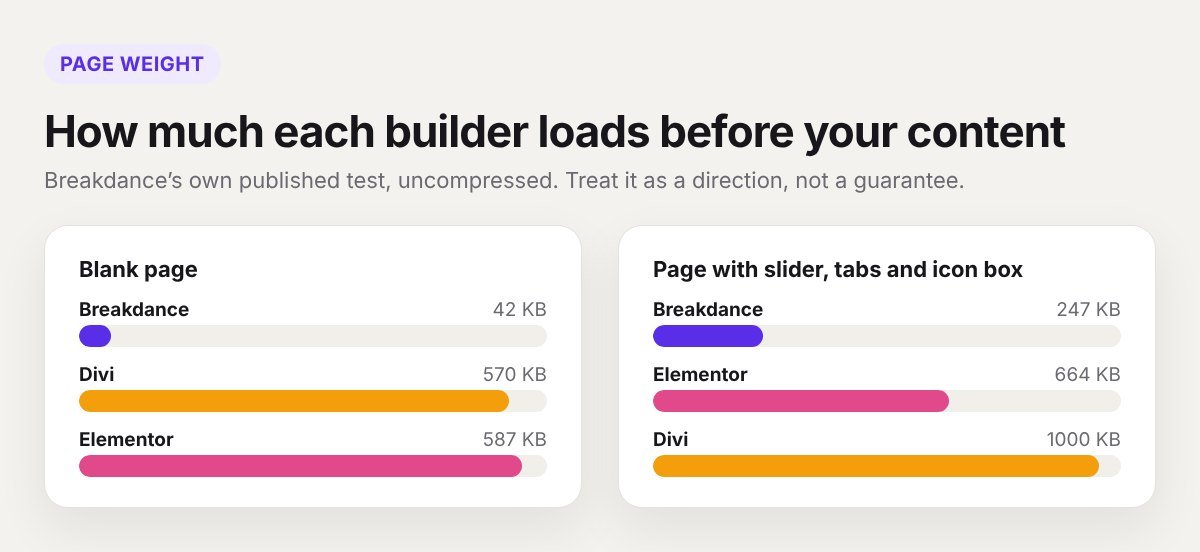
In practice, a new Breakdance site usually needs less optimisation work to pass Core Web Vitals. Elementor has improved a lot, and a carefully built Elementor site can be fast too. It simply takes more effort and more attention to which add-ons you install. Either way, the builder is only part of it. Our Breakdance speed tips apply to both.
Building speed and workflow
This is where the two feel most different.
- Breakdance replaces the theme. You build the header, footer, templates and pages in one place, with global styles, reusable classes and CSS variables. Once the design system is set, new pages go quickly.
- Elementor works with a theme, normally Hello. The widget library is huge, and almost any layout has a tutorial somewhere. The editor is familiar to a lot of people, which matters when you hire.
If you like working with classes and a real design system, Breakdance will feel cleaner. If you want to drop in a ready-made widget for everything, Elementor has more of them.
What you get without extra plugins
Breakdance Pro includes a form builder, popup builder, header and footer builder, mega menu, dynamic data, loops, conditions and full WooCommerce templates. On a typical client site, that replaces five or six plugins.
Elementor Pro covers the same areas, but which features you get depends on the plan, and many Elementor sites end up with one or two third-party add-on packs on top. Each add-on is another licence, another update and another thing that can break.
Handing the site to a client
Clients do not want a builder. They want to change a phone number without breaking the page.
Breakdance has a simplified client mode that lets an editor change text and images while the layout stays locked. That cuts down the “I broke the homepage” messages after handoff.
Elementor’s advantage is familiarity. Many clients have used it before, and so has the next freelancer they hire. If a client says “our marketing person knows Elementor”, that is a good reason to stay with it.
Where Elementor is the better choice
- The site is already on Elementor and works well. Rebuilding for its own sake wastes the client’s money.
- You need a plugin that only ships Elementor widgets.
- The client’s in-house team edits pages every day and already knows the editor.
- You rely on a large template kit that only exists for Elementor.
Where Breakdance is the better choice
- You build many sites a year and want one flat licence.
- Performance is part of what you sell.
- You want fewer plugins to maintain across a client list.
- You want to work with AI agents. Breakdance 3.0, now in release candidate, lets tools like Claude and Cursor build pages in the builder.
- You are starting a new site with no legacy to carry.
The one real gap is ready-made designs. Breakdance has far fewer third-party templates than Elementor. That gap is the reason BreakUI exists: our Breakdance templates give you a finished layout to start from, and four of them are free.
Can you switch later?
Yes, but it is a rebuild, not a conversion. No tool turns Elementor layouts into Breakdance layouts. Your content, URLs and SEO settings stay, and the pages are rebuilt. We explain the safe way to do it in how to migrate from Elementor to Breakdance without losing SEO.
Our verdict
For new client sites, we choose Breakdance. It is faster to build with once you know it, lighter on the front end, and cheaper across many sites. For existing Elementor sites that work, we leave them alone unless there is a clear reason to move, such as poor speed or a redesign that is happening anyway.

Frequently asked questions
Is Breakdance harder to learn than Elementor?
A little, at first. Breakdance expects you to think in containers, classes and global styles. Most people who have used any builder are comfortable within a week or two.
Can I use Breakdance and Elementor on the same site?
Technically yes, but we do not recommend it. You load two sets of assets and maintain two systems. Use it only as a short step during a migration.
Is Breakdance good for WooCommerce?
Yes. Shop, product, cart and checkout pages can all be designed in the builder without extra plugins.
Does Breakdance have a free version?
Yes. The free version includes around 80 elements and basic forms, popups and WooCommerce. Pro adds the full element set and design library.
Need a second opinion on your project?
Tell us what you are building and we will say plainly which builder fits. Send us a message or book a 30-minute call. If you already know you want Breakdance, start with a free template.