
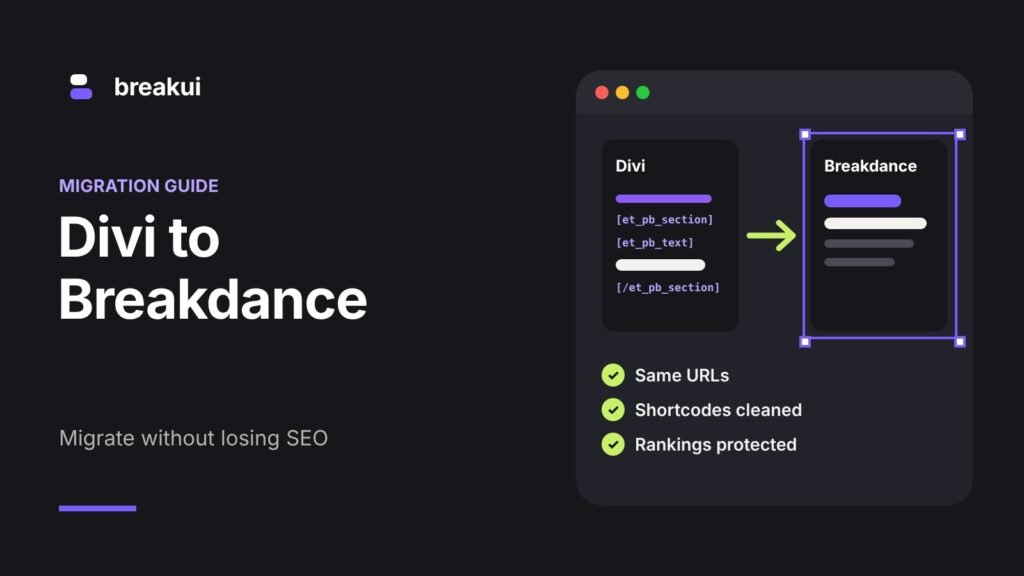
Divi has been popular for a long time, and many of the sites we are asked to rebuild started life on it. The reasons for leaving are usually the same: the site is slow on mobile, the builder feels heavy to edit, or a redesign is due anyway. This guide shows how to migrate from Divi to Breakdance while keeping your URLs, content and rankings, including the one problem that is specific to Divi: shortcodes.
Why Divi migrations need extra care
Most builders store layouts in their own data, so when you switch, your pages simply look plain. Divi 4 is different. It stores every section, row and module as shortcodes inside the post content itself. Deactivate Divi and your pages fill up with text like [et_pb_section] and [et_pb_text] wrapped around your real content.
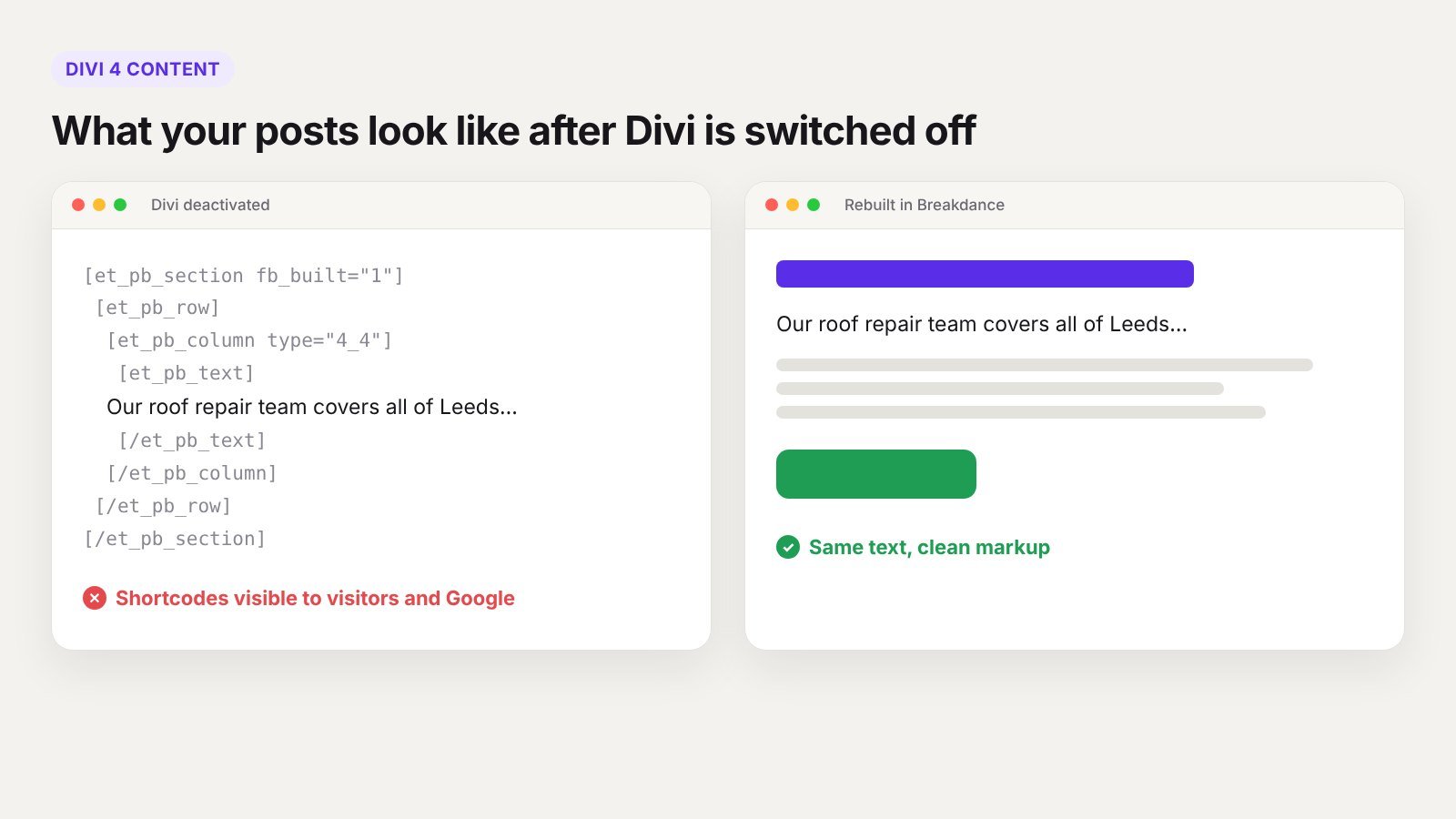
That matters for SEO in two ways:
- Visitors and Google can see the code if a page goes live without being rebuilt.
- Your real text is buried inside it, so it has to be pulled out carefully rather than copied and pasted.
Divi 5 moved away from shortcodes to a new storage format, so sites built natively in Divi 5 are cleaner to leave. Many live sites still have Divi 4 layouts in their content, though, so check before you plan anything.
Should you migrate at all?
Moving is worth it when:
- The site fails Core Web Vitals on mobile and you have tried the usual fixes
- You are redesigning anyway
- You maintain several sites and want them all on one builder
- Editing the site has become slow and frustrating
It is not worth it when the site is fast, ranks well and nobody is unhappy with it. A rebuild costs time and money, so there should be a clear gain. If you are still comparing builders, our Breakdance vs Elementor comparison covers how Breakdance works with client sites.
What stays and what gets rebuilt
There is no tool that converts Divi layouts into Breakdance layouts. A migration is a rebuild of the design on top of the same WordPress install.
Stays in place: posts, pages, URLs, media library, menus, users, SEO plugin settings, WooCommerce products and orders.
Gets rebuilt: every Divi layout, the header and footer from the Divi Theme Builder, post and archive templates, contact forms, Divi-only modules such as sliders and galleries, and any custom CSS you added in Divi’s settings.
Step 1: Measure everything first
You cannot protect rankings you have not recorded.
- Crawl the site with Screaming Frog or a similar tool. Export every URL with its title, meta description, H1, canonical and status code.
- In Google Search Console, export the top pages and queries for the last 12 months.
- Mark your money pages: the ones that bring leads, sales or most of the traffic.
- Screenshot the key pages on desktop and mobile.
- Take a full backup of files and database, and store it off the server.
Step 2: Find out how much Divi content you have
Search your posts and pages for et_pb_ in the database, or use a search-and-replace plugin in “dry run” mode. This tells you exactly which pages contain Divi 4 shortcodes. Sort them into three groups:
- Layout pages such as Home, About and Services. These get rebuilt by hand in Breakdance.
- Blog posts written in the Divi builder. These need their text extracted and cleaned.
- Blog posts written in the normal editor. These need nothing except a new post template.
The second group is where most of the work hides on content-heavy sites.
Step 3: Rebuild on staging
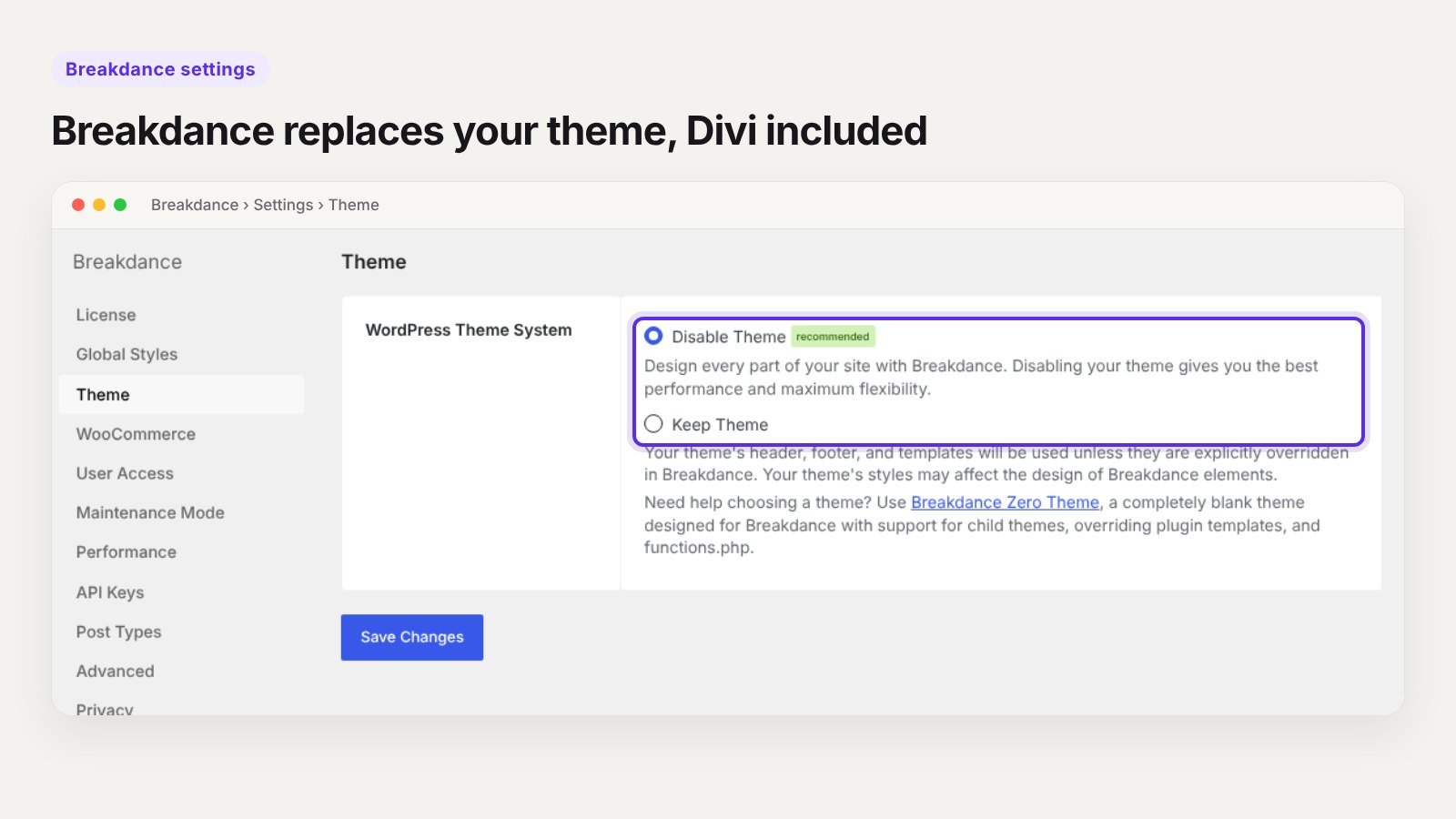
Create a staging copy and block it from search engines. Install Breakdance there. Breakdance replaces the theme, so switch to the Breakdance Zero Theme once you start building, and keep Divi available as a backup until you are finished.
Start with the parts every page shares:
- Global colours and typography
- Header and footer
- Single post template and blog archive
- Search results and 404 page
Then rebuild the pages, starting with your money pages. A finished Breakdance template can save days here, because the design system, header, footer and page layouts already exist.
Step 4: Keep every URL exactly the same
This is the most important rule in any migration. Rebuild each page on its existing URL. Do not create new pages with “-new” in the slug and plan to swap them later.
Divi users often have project pages under /project/, because Divi registers a Projects post type. If you used it, that post type disappears with Divi. You have two options:
- Register the same post type again, for example with ACF or a small snippet, so
/project/URLs keep working. - Move the projects to a new post type and add a 301 redirect for every old URL.
Keeping the URLs is safer. Redirects work, but they are one more thing to get wrong.
Step 5: Clean the shortcodes out of blog posts
For posts written in the Divi builder, the text needs to come out of the shortcodes. Options, from simplest to most technical:
- Small blogs: open each post, copy the visible text from the front end, and paste it into the block editor. Slow, but you check every post.
- Larger blogs: use a shortcode cleaner plugin to strip
et_pb_tags while keeping the text inside. Test on staging and check a sample of posts afterwards. - Very large blogs: a developer can write a script that converts the shortcode content into clean HTML in bulk.
Whatever method you use, check that headings stay headings, images keep their alt text, and internal links still work.
Step 6: Match content and headings on every page
Rankings follow content. For each rebuilt page, compare it with your crawl export:
- One H1 with the same meaning as before
- The same H2 topics in a logical order
- All body text carried over, including FAQs and small print
- Image alt text copied across
- Internal links still pointing to the same pages
Change the design as much as you like. Be careful with the words on pages that already rank.
Step 7: Rebuild forms, schema and tracking
- Rebuild every Divi contact form with Breakdance’s form builder, and send a test submission from each one.
- Check that emails arrive and that any CRM or webhook still receives the data.
- Check structured data. If a Divi module produced FAQ or review markup, recreate it with your SEO plugin or Breakdance’s FAQ element.
- Re-add analytics, tag manager, pixels and conversion events.
- Copy any custom CSS from Divi’s theme options or page settings that you still need.
Step 8: Test before launch
- Crawl staging and compare with the original export. Same URLs, same titles, same H1s, no new 404s.
- Search the database again for
et_pb_. The result should be zero, or only on pages you have deliberately left. - Test every template on phone and tablet.
- Run PageSpeed Insights on mobile for the main templates. Our Breakdance speed tips cover the common fixes.
Step 9: Launch and switch off Divi
Push staging to live at a quiet time, then straight away:
- Remove the “discourage search engines” setting.
- Deactivate the Divi theme and any Divi plugins.
- Clear all caches: page cache, CDN and the Breakdance CSS cache.
- Resubmit your XML sitemap in Search Console.
- Crawl the live site once more.
Keep Divi installed but inactive for two weeks, and keep your backup. If a page slipped through, you can still look at how it was built.
Step 10: Watch for four weeks
Small ranking movements are normal while Google recrawls the site. Check Search Console twice a week for new 404s, drops on your money pages and indexing problems. When one page drops while the rest hold, compare it with the old version. Missing text or a changed heading is almost always the cause.
How long a Divi to Breakdance migration takes
- Five to ten page brochure site: one to two weeks including testing
- Site with a blog of 50+ Divi-built posts: two to four weeks
- WooCommerce store or large content site: four to eight weeks
Cleaning old blog posts is usually the part people underestimate.
Frequently asked questions
Will I lose rankings moving from Divi to Breakdance?
Not if your URLs, content, headings, meta data and internal links stay the same. Expect small movements for a couple of weeks after launch while Google recrawls.
What happens to my Divi shortcodes when I deactivate Divi?
On Divi 4 content, they show up as raw text such as [et_pb_section] around your content. They need to be rebuilt or cleaned before the site goes live.
Is there a tool that converts Divi to Breakdance?
No. Layouts are rebuilt in Breakdance. Your content, media, users and settings stay in WordPress.
Is Breakdance faster than Divi?
Usually, yes. Breakdance only loads the code each page uses. In Breakdance’s own test, a blank page weighed 42 KB compared with 570 KB for Divi. It is a vendor test, so treat it as a direction rather than a promise.
Want us to handle the migration?
We move sites from Divi, Elementor and other builders to Breakdance, keeping URLs, content and SEO settings in place, and cleaning out old shortcodes properly. Tell us about your site and we will reply with a plan and a fixed quote, or book a 30-minute call.